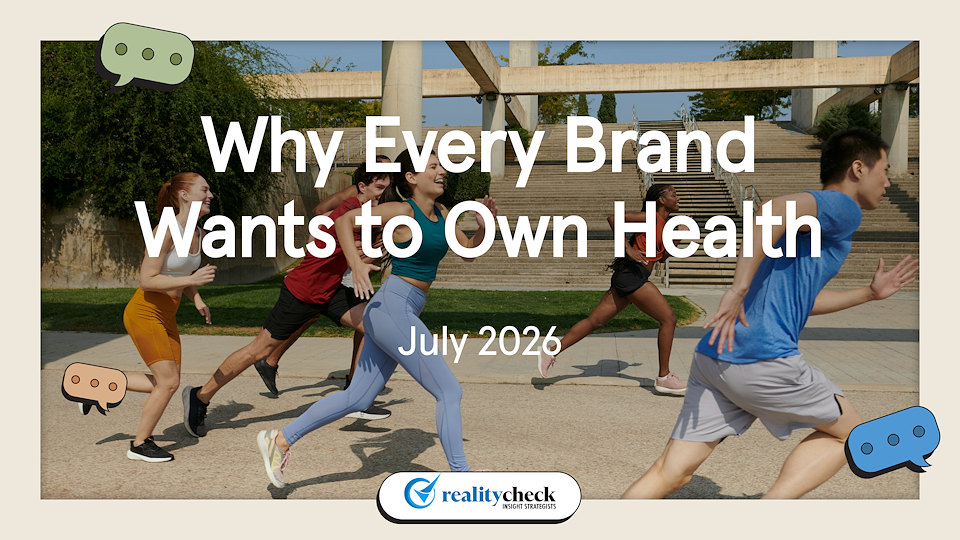
Why Every Brand Wants to Own Health
Walk through almost any grocery store today and you’ll notice something interesting.
Protein has found its way into cereal, chips, yogurt and coffee. Beverages promise hydration, gut health and cognitive support. Beauty brands increasingly talk about wellness from the inside out. Alcohol brands emphasize lower calories, active lifestyles and moderation. Personal care products promise healthier skin, healthier hair and healthier living.
Brands from categories that once competed on entirely different benefits are making remarkably similar promises. Whether they sell snacks, beverages, supplements, cosmetics or personal care products, they increasingly want to play a role in helping consumers live healthier lives.
One explanation is that companies are responding to growing consumer demand for health and wellness.
A more interesting question is why so many different categories have decided that health is the opportunity worth pursuing.
One answer is that health is not simply a product benefit. It is one of consumers’ most enduring identity aspirations.
If that’s true, it may also explain why so many brands struggle to build lasting relationships in this space. They continue to approach health primarily as a functional problem to solve when many consumers are experiencing it as an ongoing story about who they are trying to become.
Looking Beyond Functional Benefits
Most health innovation begins with product formulation.
Brands add protein. They reduce sugar, introduce functional ingredients, improve nutritional profiles and reformulate products to better align with evolving consumer expectations. These improvements have reshaped entire categories and given consumers healthier choices than they had only a decade ago.
Yet healthier products may represent only part of the opportunity.
We’ve found that health occupies a unique place in consumers’ identities. Across generations, health consistently ranks among people’s strongest aspirations. At the same time, it remains one of the largest gaps between how consumers see themselves today and how they hope to see themselves in the future.
Unlike many other identity aspirations—which often shift as people move through different stages of life—health remains remarkably consistent. Younger consumers want to become healthier. Older consumers want to become healthier. Nearly everyone feels there is still room for improvement.
That combination creates unusually strong motivation.
Consumers aren’t simply trying to consume health. They’re trying to become the kind of people who live healthier lives.
That is a very different challenge.
Why Health Never Stops Motivating Us
Several streams of academic research help explain why.
E. Tory Higgins, a psychologist at Columbia University, developed Self-Discrepancy Theory to explain how motivation often arises from the gap between people’s Actual Self and Ideal Self. The larger the discrepancy, the stronger the motivation to reduce it.
Health appears to be one of those enduring discrepancies.
Unlike buying a better phone or replacing an aging appliance, becoming healthier is rarely a goal that consumers achieve once and permanently cross off their list. It is an aspiration that continually renews itself as people age, encounter new life stages and redefine what health means for them.
Research by Derek Rucker, Kelly Mandel and Adam Galinsky on compensatory consumption offers another piece of the puzzle. Their work suggests that consumers often use products and brands to help manage identity gaps. Brands become resources people draw upon while pursuing preferred versions of themselves.
Taken together, these ideas point toward an intriguing possibility. Consumers may not simply be evaluating whether a product is healthier. They may also be asking whether a brand supports the person they are trying to become.
Health Is a Story, Not a Destination
Dan McAdams, a Northwestern University psychologist and one of the leading scholars of Narrative Identity, argues that people make sense of their lives through stories.
Those stories are rarely about perfection.
They are about progress.
People exercise consistently for a while and then fall out of the habit. They commit to healthier eating before returning to familiar routines. They lose weight, regain some of it and begin again. They promise themselves that next Monday will be different, and sometimes it is.
Very few people experience health as a destination. Most experience it as an ongoing story with advances, setbacks and fresh starts.
McAdams’ research has shown that psychologically healthy people often construct what he calls redemptive narratives—stories in which setbacks become part of personal growth rather than evidence of permanent failure.
Health fits naturally within this kind of narrative.
The healthiest identity is often not, “I am perfectly healthy.”
It is, “I am becoming someone who takes better care of myself.”
That may sound like a subtle distinction, but psychologically it is a profound one. One identity demands perfection. The other leaves room for growth.
Where Many Brands Miss the Opportunity
This perspective may also explain why so much health marketing feels strangely unsatisfying.
Much of it reinforces the very identity tension consumers are trying to resolve.
Advertising is filled with flawless bodies, perfect routines and idealized lifestyles. The message is often implied rather than stated, but consumers understand it all the same: you still have work to do.
That approach can certainly create motivation. Self-discrepancy is a powerful psychological force.
Over time, continually reminding people how far they remain from an ideal may become exhausting. Consumers rarely need another reminder that they should eat better, exercise more or sleep longer. Most already believe those things.
What they may be looking for is something quite different.
They may be looking for brands that acknowledge the journey they are already on.
The difference is subtle, but meaningful.
One brand says, “Here’s everything that’s wrong with you.”
Another says, “You’re making progress, and we’re here to support it.”
One emphasizes the gap.
The other affirms the journey.
Narrative psychology suggests those are very different experiences.
From Health Claims to Health Stories
As more categories converge around health, functional advantages will become increasingly difficult to sustain. Protein can be copied, ingredients can be matched and nutritional claims eventually become table stakes. Every successful innovation invites imitation.
The harder competitive advantage may lie in the role a brand plays in consumers’ ongoing stories.
Brands do not simply sell products. They invite people into narratives about becoming stronger, building healthier habits, caring for their families, aging well, finding balance or taking greater control over their lives.
The most meaningful brands rarely promise instant transformation. Instead, they reinforce the belief that meaningful change is possible and that consumers are already moving in the right direction.
That is a fundamentally different role than simply delivering a functional benefit.
A Different Question for Brand Leaders
For years, marketers have asked a familiar question:
How can our brand participate in health and wellness?
It may be time to ask a different one:
How can our brand support—and affirm—a consumer’s ongoing story of becoming healthier?
Those questions lead to very different conversations.
The first begins with product features and functional claims. The second begins with people. It asks what kind of story the brand invites consumers to tell themselves. Does it reinforce guilt or encourage progress? Does it celebrate perfection or acknowledge the reality of everyday life? Does it leave consumers feeling judged, or does it help them believe they are already becoming the person they hope to be?
These questions sit at the heart of RealityCheck’s work on Narrametric Analysis™ and Narrative Power. Narrametric Analysis™ quantitatively measures the role brands and product categories play in consumers’ Narrative Identity, the internal stories people tell themselves about who they are and who they are becoming. Brands become more meaningful when they do more than solve problems. They help consumers construct stories about who they are and who they are becoming.
The Next Battleground
Health is unlikely to become less important. If anything, more categories will continue moving into the space as consumers seek products that support longer, healthier and more active lives.
That also means functional health claims will become increasingly common.
The brands that stand apart may not be the ones making the strongest health promises. They may be the ones that help consumers build the strongest health stories.
Consumers aren’t simply trying to consume health. They’re trying to become the kind of people who live healthier lives.
The brands that understand that difference won’t simply participate in the health and wellness market. They’ll become trusted companions in one of the most enduring identity journeys consumers ever undertake.
That is where Narrative Power begins.